Published on
- 4 min read
Health Savings Accounts: The Most Powerful Savings Vehicle Most Americans Ignore

Most people treat their HSA like a medical debit card. Financial planners treat it like a retirement super-fund. If there is one financial account that most Americans misunderstand, it is the Health Savings Account. The typical person sees their HSA as a place to store pre-tax dollars for next year’s doctor visit. But financial planners who understand tax law see the HSA differently — as the single most tax-advantaged account in the U.S. financial system.
What Is an HSA, Exactly?
A Health Savings Account is a tax-advantaged account available to anyone enrolled in a High-Deductible Health Plan (HDHP). To be eligible in 2026, you must be covered by a qualified HDHP on the first day of the month, not be enrolled in Medicare, and not be claimed as a dependent on someone else’s tax return.
A qualified HDHP, per IRS 2026 standards, must have:
- A minimum annual deductible of $1,650 for self-only coverage or $3,300 for family coverage
- An out-of-pocket maximum of no more than $8,500 for self-only or $17,000 for family
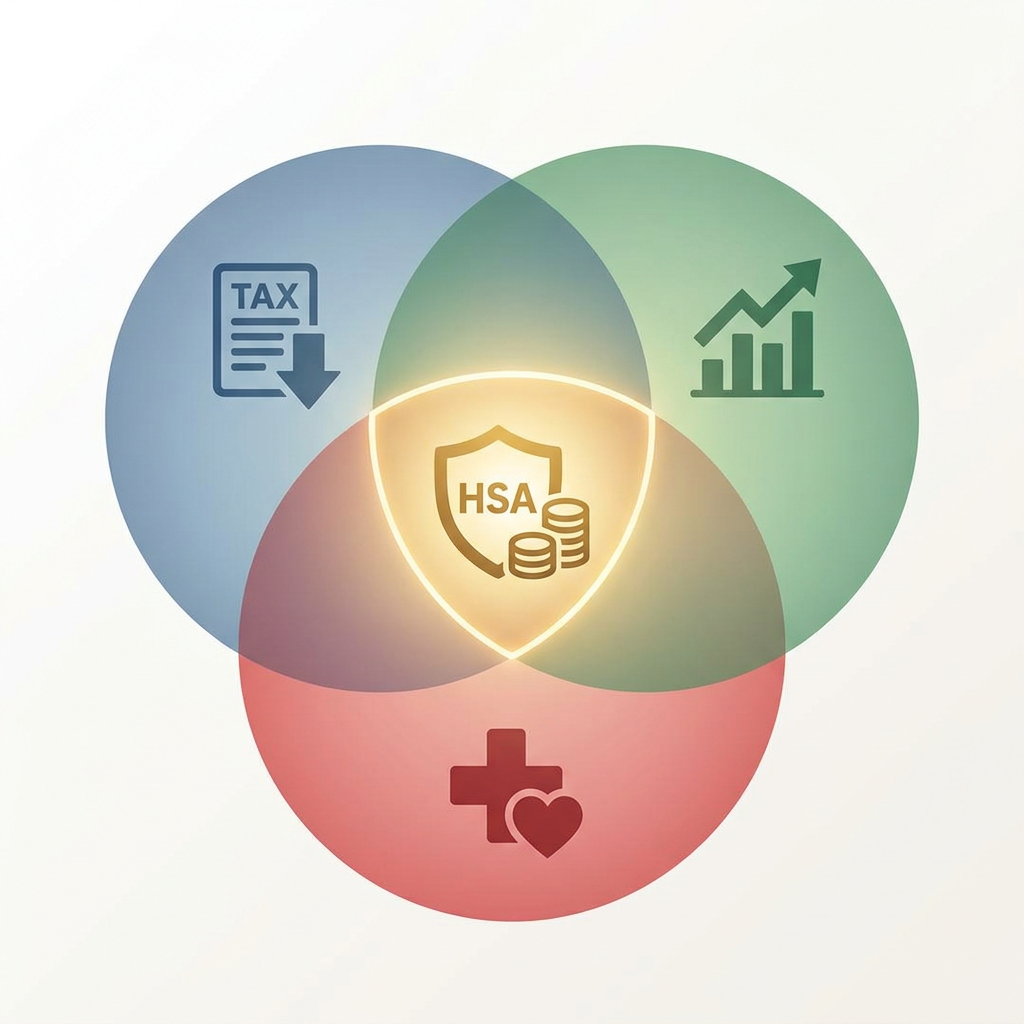
The Triple Tax Advantage: Why HSA Is in a League of Its Own
No other account in the U.S. tax code offers three simultaneous tax benefits. The HSA does:
1. Contributions are tax-deductible. Money you put into an HSA reduces your taxable income. If you are in the 24% tax bracket and contribute $4,400 to your HSA, you save $1,056 in federal income taxes that year.
2. Earnings grow tax-free. Interest, dividends, and capital gains inside the HSA all accumulate tax-free. Unlike a 401(k), where you will eventually pay taxes on every dollar you withdraw, the HSA does not tax your growth — ever, for any reason.
3. Withdrawals for qualified medical expenses are tax-free. When you use HSA funds for doctor visits, prescriptions, dental work, vision care, or any of the IRS-qualified expenses, you pay zero tax on the withdrawal.
No 401(k) offers all three. Traditional accounts give you deduction and tax-deferred growth, but withdrawals are taxed. Roth accounts give you tax-free growth and withdrawals, but contributions give you no deduction.
2026 Contribution Limits
- $4,400 for self-only coverage
- $8,800 for family coverage
- An additional $1,000 catch-up contribution for individuals age 55 and older
Contributions can be made until the tax filing deadline (April 15 of the following year).
The Strategy: Invest, Do Not Just Save
The most powerful HSA strategy is also the one few people use: pay your medical expenses out of pocket and let the HSA money grow untouched for retirement.
Here is why. If you pay a $2,000 medical bill from your checking account instead of your HSA, you leave the $2,000 invested inside the HSA for decades. At a 7% annual return, that $2,000 becomes roughly $15,000 over 30 years — and every dollar comes out tax-free for qualified expenses.
The IRS does not require you to reimburse yourself in the same year the expense occurs. You can save receipts, let the HSA grow, and reimburse yourself years or decades later, when the invested money has compounded significantly.
What Counts as a Qualified Expense
IRS Publication 502 defines qualified medical expenses. The broad categories include:
- Doctor visits, hospital stays, and surgery
- Prescription drugs
- Dental and vision care (including glasses, contacts, and orthodontia)
- Mental health care and therapy
- Long-term care insurance premiums (within IRS limits)
- Medicare premiums (Parts B, D, and Medicare Advantage) after age 65
- COBRA premiums and health insurance premiums while receiving unemployment
Over-the-counter medications are eligible without a prescription since the CARES Act of 2020.

HSA as a Retirement Account
After age 65, the HSA transforms. You can withdraw funds for any purpose — not just medical expenses — subject only to ordinary income tax, just like a Traditional IRA. But withdrawals for qualified medical expenses remain completely tax-free at any age.
This makes the HSA the ultimate retirement account for healthcare costs. Fidelity estimates that a 65-year-old couple retiring in 2026 will need approximately $315,000 to cover healthcare expenses in retirement. An HSA funded and invested over a career can cover a significant portion of that.
The Bottom Line
The HSA is not a medical spending account. It is a retirement account with a healthcare door. The households that use it best are the ones that contribute the maximum, invest the balance, pay current medical expenses from other funds, and let the triple-tax-advantaged growth work for decades.
If you are eligible, max it out. If you are choosing between a traditional plan and an HDHP, run the numbers — the HSA’s tax advantages often outweigh the higher deductible, especially for households with predictable medical needs. The HSA is the most underutilized wealth-building tool in the American tax code. Do not leave it on the table.

Related Articles

Why Your Savings Account is Costing You Money
Discover why keeping all your money in a traditional savings account might be silently eroding your ...

Compound Interest: The Most Powerful Force in Finance
Discover why Einstein called compound interest the eighth wonder of the world and how to harness its...

401(k): Your Employer Is Offering Free Money
Do not leave free money on the table. Learn why employer 401(k) matching is the easiest wealth-build...