Published on
- 3 min read
High-Yield Savings Accounts: Where to Park Your Cash in 2026
Why 5% APY Exists in the First Place
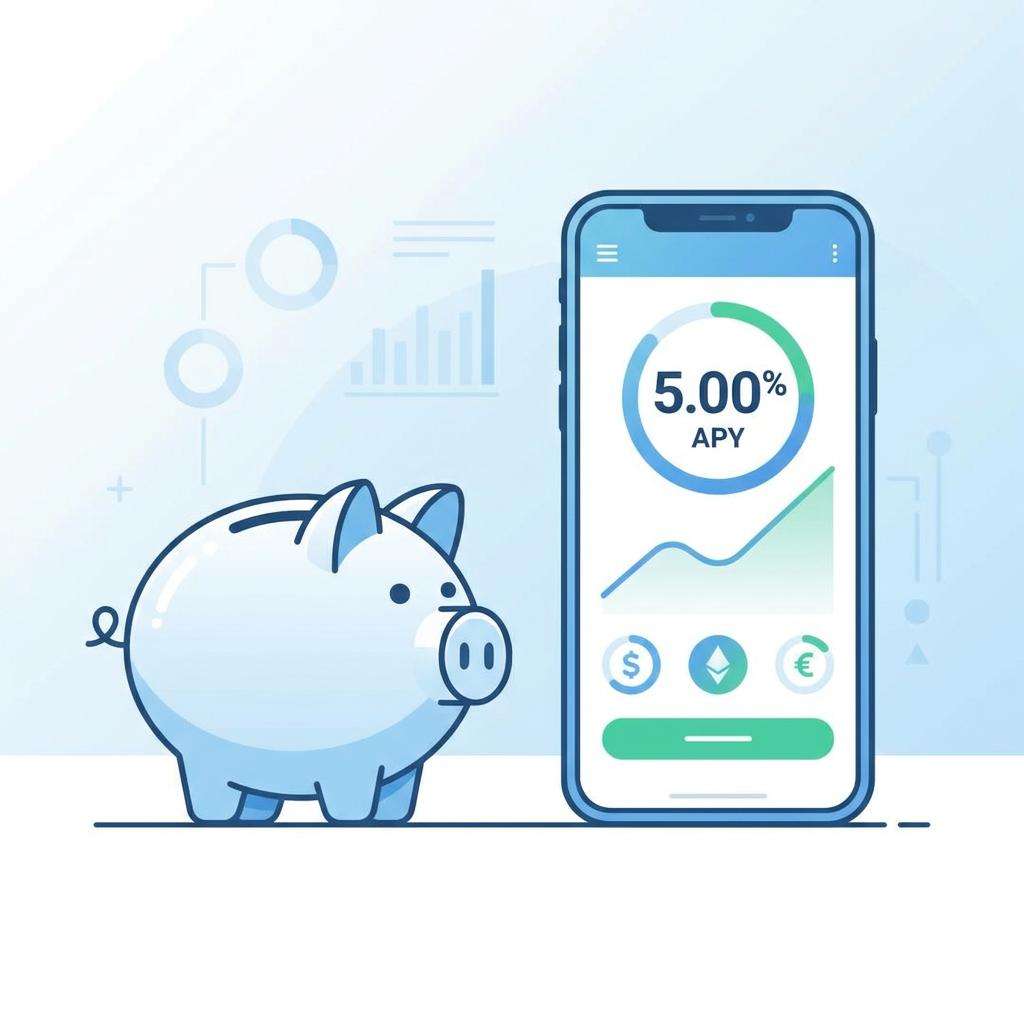
The national average savings account pays about 0.40% APY. The best high-yield savings accounts in June 2026 are paying 5.00% APY more than ten times that rate. If you keep your emergency fund, your down payment savings, or any cash you do not need this month in a regular checking or savings account, you are giving up roughly $4,000 to $5,000 a year on a $100,000 balance. To understand why the gap is so wide, look at what your bank actually does with deposits: it lends most of it out at higher rates mortgages, auto loans, credit cards, commercial credit. The difference between what the bank pays you and what it charges borrowers is its net interest margin. Traditional banks have physical branches, hundreds of employees, and marketing budgets to support; online banks have none of that overhead, so they pass the savings to you as higher APYs.

What 5% APY Actually Looks Like
A 5.00% APY on a $50,000 balance generates $2,250 in interest over a year. The same balance at 0.40% generates $200. The difference is $2,150. On a $25,000 balance, the gap is roughly $1,600 a year. On $250,000 the FDIC insurance ceiling at a single bank the gap is over $11,500 a year. These are not rounding errors. Most people are sitting on tens of thousands of dollars in low-yield accounts without realizing how much that costs them annually. The math also works at smaller balances: a $10,000 emergency buffer at 5% vs 0.40% earns about $460 more per year. Small individually, but cumulative across households.
How FDIC Insurance Works at Online Banks
The most common hesitation about online banks is safety. The answer is the Federal Deposit Insurance Corporation. The FDIC insures deposits at member banks up to $250,000 per depositor, per insured bank, per ownership category. If the bank fails, the FDIC returns your money typically within a few business days. Marcus by Goldman Sachs, SoFi, Discover, Capital One, Ally, Amex High-Yield Savings, and Synchrony are all FDIC-insured. You can verify a bank’s FDIC status at the FDIC’s BankFind tool before opening an account. If you have more than $250,000 to deposit, split the funds across multiple banks or use a single bank with different ownership categories. For most households this is academic, but for those with concentrated cash from a home sale or inheritance, it matters. Credit unions carry equivalent coverage through the NCUA.
The Real Trade-Off: Access vs. Yield
High-yield savings accounts are not magic. They have constraints. Most are variable-rate, meaning the bank can change the APY at any time when the Fed cuts, your APY drops within days. Liquidity is generally strong: ACH transfers in one to three business days at most major online banks. Customer service is slower than a branch, since there is no branch. A few banks still publish a six-withdrawal-per-month policy inherited from Regulation D, but enforcement is rare.

The Bottom Line
The gap between high-yield savings and traditional accounts is not a minor difference. It is one of the largest guaranteed returns available in personal finance, with essentially zero risk. If you have cash sitting in a checking or traditional savings account, moving it takes under an hour and pays you back every month. Rates will eventually fall when the Fed cuts, but until then, the 5% is here. It is free money for anyone willing to spend 15 minutes moving it.
Sources: FDIC National Rate Cap Data, June 2026; Federal Reserve FOMC Statement and Press Conference, April 2026; CME FedWatch Tool, June 2026; Bureau of Economic Analysis Personal Income and Saving Data, Q1 2026; Fortune Recommends High-Yield Savings Rankings, June 2026; Investopedia Daily Rate Tracker, June 2026; TreasuryDirect Auction Results, June 2026.
Related Articles

Emergency Fund: Your First Financial Priority
Learn why an emergency fund is the foundation of every sound financial plan, how much you need, wher...
How to Build an Emergency Fund in 2026: Your Financial Safety Net Starts Here
Learn the practical steps to build a six-month emergency fund in 2026, where to keep it for maximum ...

CD Laddering Strategy: Lock In High Rates Without Locking Up All Your Cash
A comprehensive guide to understanding personal finance....